
Conditions · Hip pain
Hip Pain Treatment in Midtown NYC
Groin, outer hip, and buttock pain — including when an MRI says “labral tear.”
Hiro Nakano, DC, DACBSP · Team USA medical staff · In Midtown since 2010
How I help
Hands-on care first. Then build the capacity.
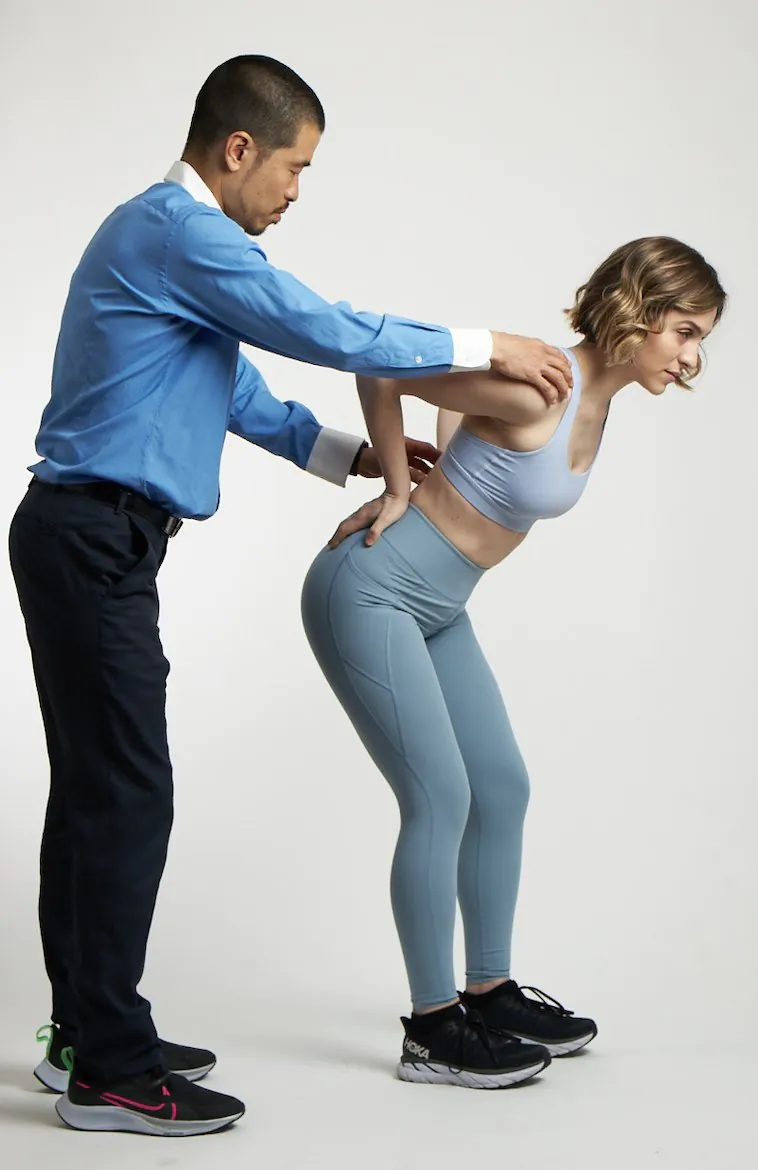
Hands-on care is the core of my work — joint mobilization and soft-tissue treatment chosen from that day’s exam. It has been my family’s craft for four generations, since 1926, and it’s often what changes pain and movement fastest.
But feeling better on the table isn’t the same as being ready for your old mileage. Many people feel good, go straight back to their usual training, and the pain comes back. So we rebuild hip strength and single-leg control step by step, and check how you respond the next day.
X-rays are useful for arthritis and bone shape; MRI or ultrasound make sense when the exam points to something specific and the result would change the plan.[1] When imaging is needed, I can order it directly. Surgery helps some people: in a UK trial of patients with symptomatic hip impingement (FAI), both surgery and physiotherapy-led care improved, and at 12 months the surgery group had better hip-related quality of life on average.[2]
So I don’t think you should rush to surgery because an image shows a tear — or keep doing care that isn’t working just to avoid it. If you need an orthopedic surgeon, I’ll tell you, and help you get there.
The truth about hip pain
X-ray findings and hip pain often don’t match.
In two large U.S. studies with about 4,500 people, only 9–16% of frequently painful hips showed osteoarthritis on X-ray. And only 21–24% of hips with osteoarthritis on X-ray were frequently painful.[3] That’s why I don’t rely on an image to tell me whether the pain is coming from your hip, your back, or somewhere else. The exam does that.
For hip arthritis, exercise is the foundation. Hands-on care has a place too.
For hip osteoarthritis, an exercise program built for the individual is core treatment. UK national guidelines recommend that manual therapy, when used, be combined with exercise.[4] In one trial of 109 people with hip osteoarthritis, 81% had improved after five weeks of manual therapy, compared with 50% after exercise therapy, and the benefits of manual therapy lasted at 29 weeks.[5] Other trials have been mixed, so I use both.
A labral tear on MRI doesn’t automatically mean surgery.
The labrum is a rim of tissue around the hip socket. Hearing the word “tear” is scary — it sounds like something that will keep getting worse until it’s repaired. But labral tears also show up in people with no hip pain at all. In a study of 21 professional hockey players with no hip symptoms, 15 had a labral tear on MRI, and most kept playing over the next four years without missing games because of their hip.[6] It was a small study, but a larger review that pooled many studies found labral tears in 54% of people with no hip pain, compared with 62% of people with hip pain.[7] What’s on the image and what’s causing your pain aren’t always the same thing. The exam has to match the MRI.
Pain on the side of the hip is rarely just “bursitis.”
Outer hip pain has long been labeled bursitis. Yet in an ultrasound study of 877 patients with this kind of pain, about 80% showed no bursitis, and about half showed changes in the gluteal tendons.[8] Imaging alone can’t settle the cause, but it’s a good reason to look beyond inflammation — at tendon load, hip strength, and how you stand and walk. In a clinical trial for gluteal tendon pain, education on managing load plus exercise did better than a steroid injection at 8 weeks and led to more overall improvement at one year, though pain intensity at one year was similar.[9] Sleeping on the painful side, crossing your legs, or hanging on one hip while you stand can all keep loading those tendons.
Your first visit
About 90 minutes, $300. I listen, examine you, rule out anything that needs other medical care, and explain what I find in plain language. You leave with hands-on treatment, exercises you can start right away, and a written summary of the plan. When imaging is truly needed, I can order X-rays or MRI directly — no referral required.
Not sure yet? Text me first.
By now you’ve probably heard a lot of different opinions and searched for a lot of answers. I understand that completely — I’d feel the same way. If you have questions, send a text to 212-931-8544 and ask. Most things make more sense once we talk. Come in when it makes sense to you.
Common questions
Is it my hip or my lower back?
Often you can’t tell from where it hurts, and an X-ray alone rarely settles it — what shows on an image and where the pain comes from often don’t match. A hands-on exam of both your back and your hip usually can. Sometimes imaging helps too. If your back turns out to be the main driver, we treat it as low back pain.
Do I need an MRI for hip pain?
Not always. If the exam shows that imaging would change the plan, I can order X-rays or an MRI directly — no referral needed. If you already have images or reports, bring them to your first visit.
I was told I have a labral tear. Do I need surgery?
Not necessarily. Labral tears also show up in people without pain, so the image alone can’t decide. First we check whether your symptoms match the finding and whether conservative care is likely to help. If it isn’t enough, surgery is a real option, and I’ll help you get to the right surgeon.
I have hip arthritis and was told I need a hip replacement. Should I do it?
Hip replacement has a high success rate, and most people do well. Still, nobody wants surgery they don’t need. The right timing depends on your goals, your life, and your plans — and it can’t be decided from an image alone. We look at how your hip moves, how much hands-on care and exercise help, and how much it limits your life. If surgery looks like the better path, I’ll recommend it. Some people do well without it. Let’s talk it through.
When should hip pain be checked right away?
Go to urgent care or the ER if you can’t put weight on your leg after a fall, if hip pain comes with a fever, or if the pain is sudden and severe. See a doctor promptly if the pain keeps you up at night even at rest, or if you have a history of cancer and new hip pain.
Ready to get back to what matters?
You don’t need to be fit or confident to start. Tell me what’s bothering you and what you want to be able to do again.
References
- American College of Radiology. ACR Appropriateness Criteria: Chronic Hip Pain, 2022 Update. J Am Coll Radiol. 2023. PubMed
- Griffin DR, et al. Hip arthroscopy versus best conservative care for the treatment of femoroacetabular impingement syndrome (UK FASHIoN): a multicentre randomised controlled trial. Lancet. 2018. The Lancet
- Kim C, et al. Association of hip pain with radiographic evidence of hip osteoarthritis: diagnostic test study. BMJ. 2015;351:h5983. BMJ
- National Institute for Health and Care Excellence (NICE). Osteoarthritis in over 16s: diagnosis and management (NG226). 2022. NICE
- Hoeksma HL, et al. Comparison of manual therapy and exercise therapy in osteoarthritis of the hip: a randomized clinical trial. Arthritis Rheum. 2004;51(5):722-729. DOI
- Gallo RA, et al. Asymptomatic hip/groin pathology identified on magnetic resonance imaging of professional hockey players: outcomes and playing status at 4 years’ follow-up. Arthroscopy. 2014. PubMed
- Heerey JJ, et al. What is the prevalence of imaging-defined intra-articular hip pathologies in people with and without pain? A systematic review and meta-analysis. Br J Sports Med. 2018. BJSM
- Long SS, et al. Sonography of greater trochanteric pain syndrome and the rarity of primary bursitis. AJR Am J Roentgenol. 2013. PubMed
- Mellor R, et al. Education plus exercise versus corticosteroid injection use versus a wait and see approach on global outcome and pain from gluteal tendinopathy: prospective, single blinded, randomised clinical trial. BMJ. 2018;361:k1662. BMJ